

A perspective from Cyberwave and Apeiroon
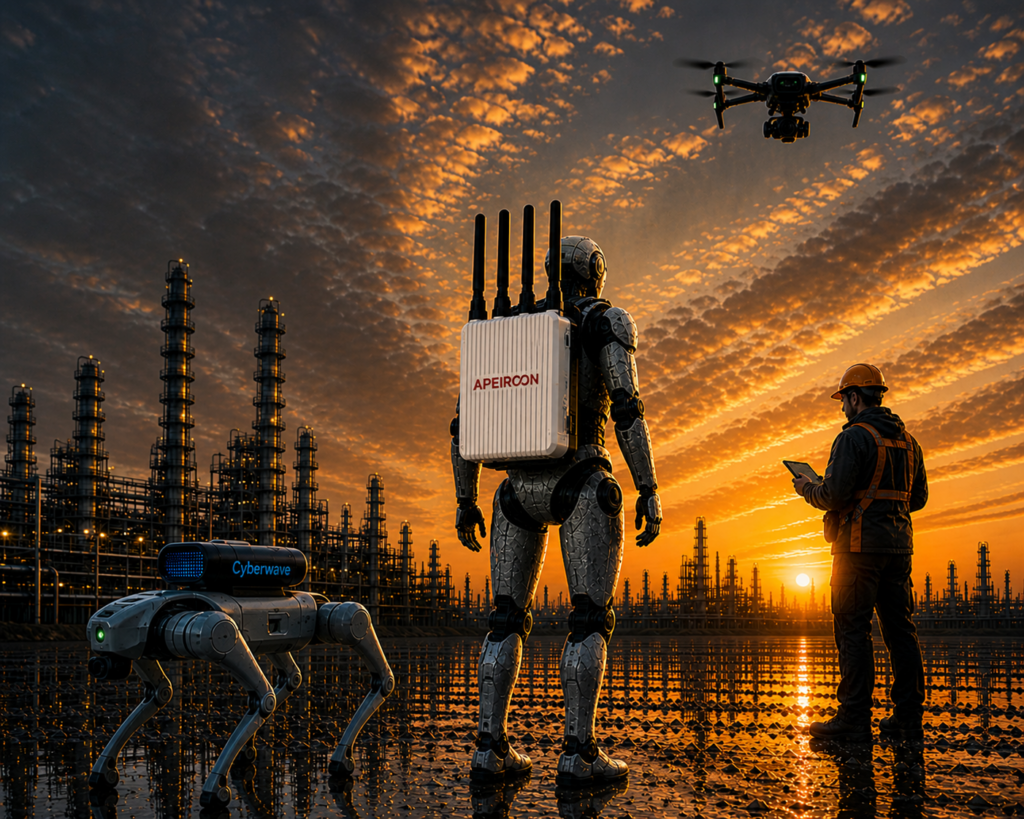
Physical AI moves artificial intelligence from digital systems into machines that sense, decide, and act in the physical world. This shift changes the role of connectivity. Mobile robots, drones, and autonomous systems do not merely need access to a network. They need predictable communication while moving through environments shaped by contention, changing radio conditions, handovers, interference, and operational stress.
As fleets scale, the communications layer becomes a defining part of the system architecture. It determines how shared state is maintained, where inference can run, how machines coordinate, how operators remain informed, and how safely the system degrades when conditions change. Enterprise Wi-Fi and public cellular can support parts of this stack, but mission-critical mobile autonomy requires a more controllable communications substrate.
This paper argues that private mobile networks, combined with edge AI and fleet orchestration, forms a new category of Mobile AI Infrastructure: the integrated layer that enables Physical AI in motion. Its role is not simply to connect robots. It is to make connectivity, compute, inference, orchestration, and fallback behaviour co-designable.
The central design question is therefore no longer whether a robot is connected. It is which inference workloads can safely leave the robot, under which network conditions, with what service guarantees, and with what fallback behaviour when those conditions degrade. For Physical AI to scale, connectivity must become explicit, measurable, and engineered as part of the autonomy stack.